



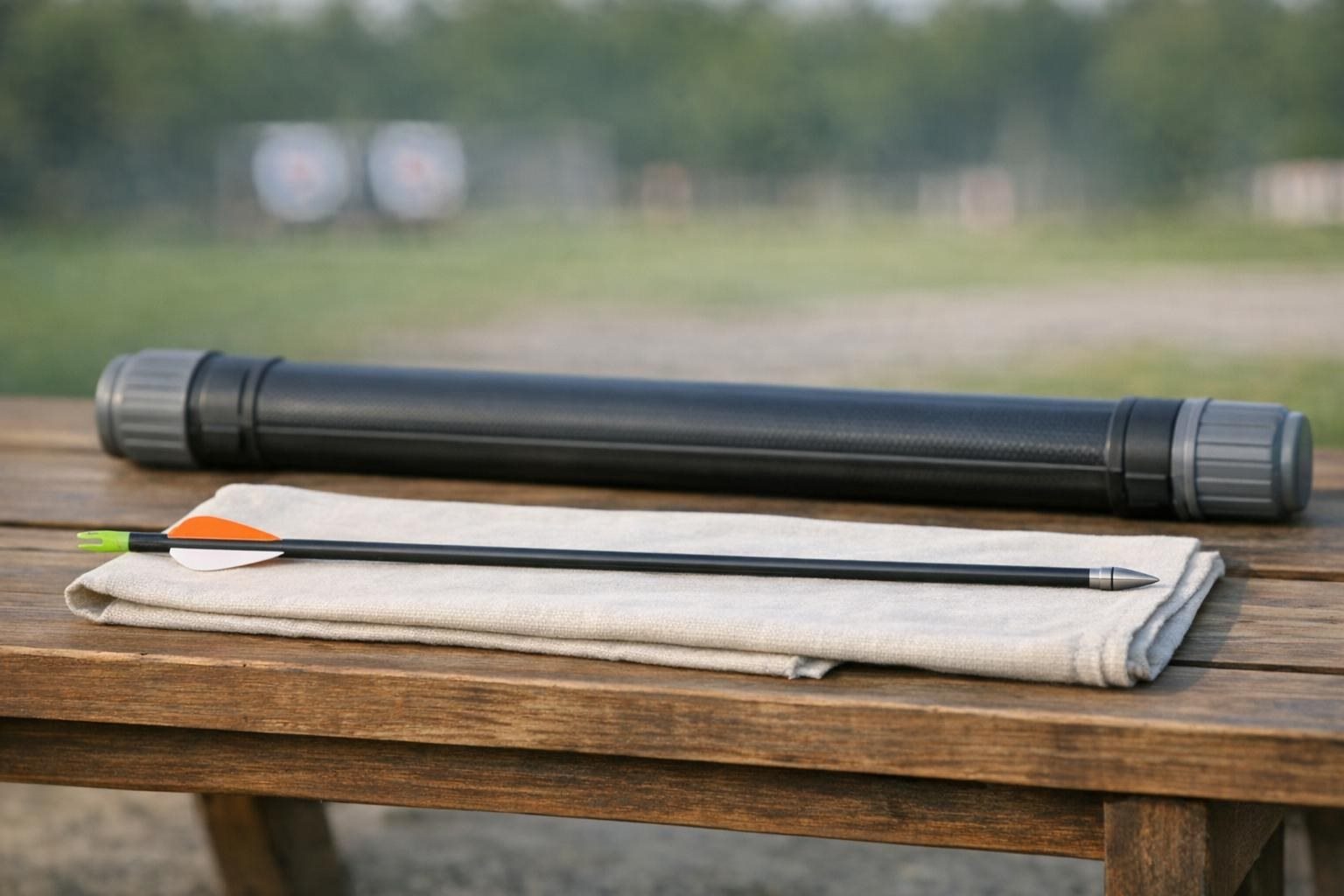
A damaged arrow is easy to miss when clean arrows for shooting, practice arrows for tuning and arrows that need inspection are all stored in the same case. By organizing your arrows for shooting in a simple manner as you put them away after a shooting session, you ensure that you can easily identify any arrows that may have suffered damage in shooting. You will also be able to easily identify any parts such as arrow shafts, arrow inserts, arrow nocks and arrow fletchings that may need further inspection before you use them for shooting again.
Start with the moment damage is most likely to be missed
Organize as you put your arrows away after a shooting session. Many problems with arrows are discovered in the field and will disappear in your quiver or case. By organizing your arrows into different groups of possible problems as soon as possible, you can be sure to remember the problems you found with your arrows.
This holding area is a temporary repository of your arrows – typically situated on the range or at the target. As with any holding area, it can be part of your arrow case, an open tray, or even a short stand – designed to hold arrows of similar design. The arrows are not stored for long periods of time in this area, merely to serve as a pause point between shooting and organizing your arrows for subsequent shoots.
Any time that you suspect a problem with an arrow it should be placed in the questionable group. This includes arrows that have been involved in a robin-hood style collision, hit the edge of a target hard, were shot into the ground, or came into contact with something other than a target backstop after having been shot. Why suspect a problem with an arrow you shot into a tree? Later, when you can't find it, you may recall that it was shot into a tree.
Sort by condition, not by convenience
There are three useful categories to sort your arrows into for storage: ready for practice, needs inspection and retired/repairing.
Arrows that have passed a basic inspection are stored in the "Ready for Practice" section. Those that have unknown history or obvious signs of damage are stored in the "Needs Inspection" area. Finally, there is the "Retired" or "Needs Repair" section where questionable arrows are stored until they can be repaired, used for non-shooting activities or disposed of in an appropriate manner.
Try to avoid classifying your arrows as "old" or "mixed". Instead label them with a large handwritten label or with a colored band around the case. It doesn't matter how you organize your arrows, as long as it is obvious what status an arrow has been given when you close up the case for storage.
If you have arrows of different types for target shooting and for hunting then it is best to keep them separated for practice shots also, to trace any damage caused by impact with another arrow.
Choose storage that exposes the parts you need to see
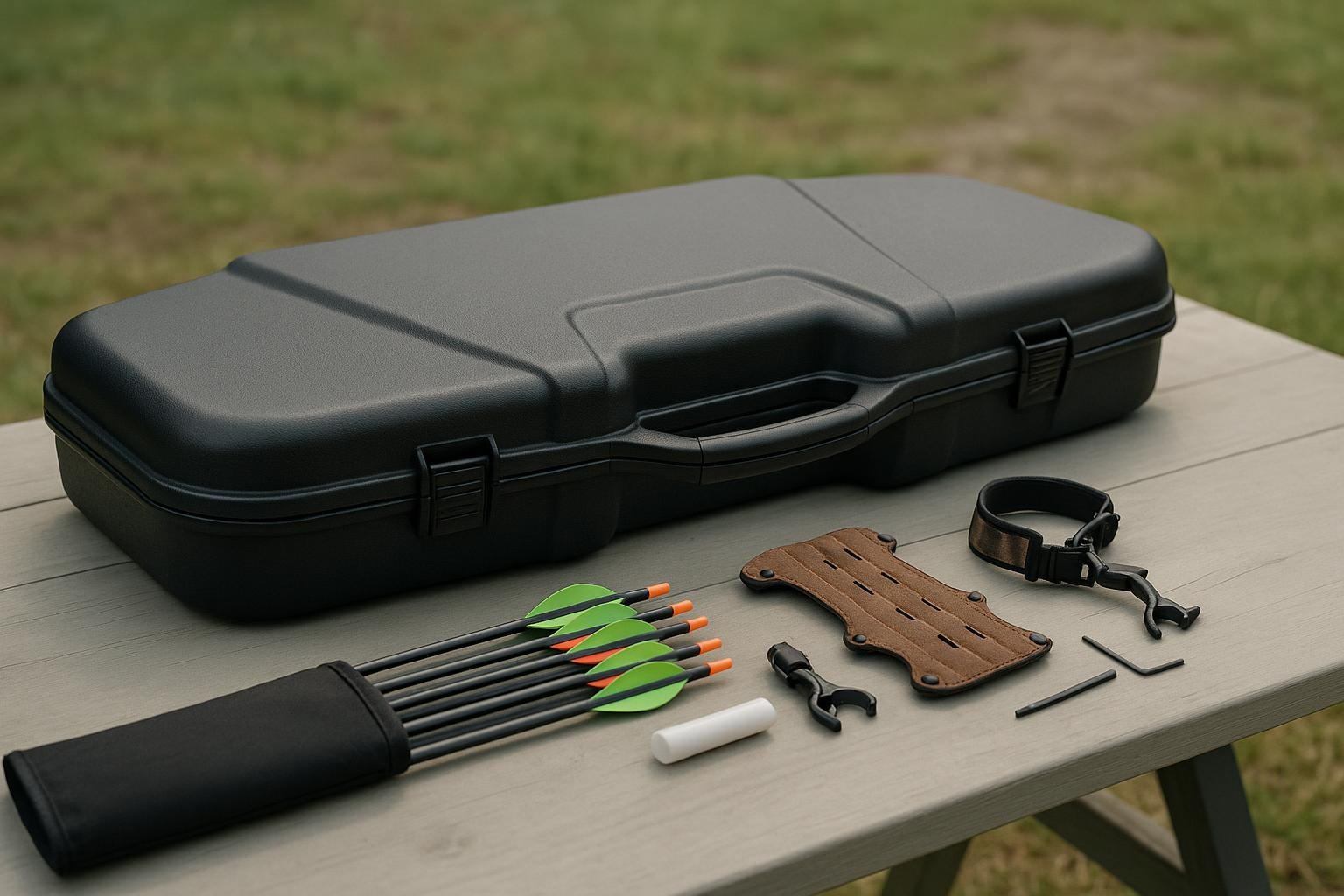
Closed tubes for arrows are mainly good for transport. For checking them on your workbench for possible damage in shooting, open containers are much better. You can lay the arrows parallel to each other and check the fletchings and nocks. There should also be enough space between the arrows so that they do not get pressed together. Arrows can be stored in a rack or in a shallow box divided into compartments.
A rack, a divided box or even a shallow container are ways to store arrows parallel to each other. In such a case make sure that the nocks and fletchings are visible. Small groups of arrows in a case, clearly divided by a spacer (arrow divider), can also be stored to facilitate inspection.
The simplest way to ensure traceability of the arrows shot is to make use of the system as it is. If you use a number on the arrows, make sure you update the notes after each time they are shot. If you don't update the notes, then a complex system of numbers has been introduced that will only cause problems in the long run.
Make arrow inspection a repeatable bench check
When you go to put an arrow back in your quiver after practice, inspect it under good light. Look for any signs of cracking or splintering along the length of the arrow. Rotate the arrow to view it from different angles. Sometimes, damage to an arrow is more visible when viewed from a different angle than when it is held straight.
For the nock: are there splits or has the nock loosened up? Is it crooked or does it no longer fit properly? For the vanes: are the edges of the vanes lifting up? Are there any tears? Are there any contact marks? For the insert and point: is there any looseness? Is it misaligned? Are there any signs of impact?
Visual inspection alone of arrows is not a guarantee of their safety. The shafts must not be bent or flexed in any manner. Testing for strength by driving the arrow into the ground or against a solid surface can cause further damage. If during the course of inspection, any arrows are found to have cracks or signs of wear, then they must be taken out of circulation immediately until they can be assessed for possible repair.
Compare questionable arrows with those of similar make and model that you know shoot well (i.e. your practice arrows). The differences in appearance, sound, etc. are generally more noticeable when comparing similar arrows side by side. Manufacturer recommendations and local laws can dictate how certain materials and components can be repaired, reused or disposed of.
Record what practice is teaching you
Recording what damage your practice arrows sustain is perhaps more useful than organizing your arrows. Be sure to record date, arrow and reason for the move to the inspection arrows. Target arrows get a lot of wear, so it is not surprising that most damage is concentrated on the shaft near the arrowhead. You can determine if the damage was caused by hitting a hard surface or another arrow, or by a loose vane etc.
These notes can give you insight as to the causes of damage to your arrows in target practice and/or archery tags. For example, repeated damage to the vane(s) in the same area could be due to the arrow coming into contact with the rest of the arrow, or another arrow, or the tags themselves. This would indicate that the damage is caused by the target, and not by any fault of the arrow.
This note can be attached to the arrow(s) that were shot, or in the bag or tackle box where that gear is stored. A simple note on a smart phone can also work as long as it uses the same identifiers (e.g. color code, letters) as the arrows in the case. However, a note that cannot be linked to the correct arrow(s) is of little value when there are many arrows of similar type and appearance.
Set a firm boundary for hunting equipment
Hunting equipment is a different animal from target practice arrows. Do not choose an arrow with structural unknowns just because you can't see the damage. The key to ethical bowhunting is to use reliable arrows, have plenty of practice shooting them, and use good judgment when you are in the field. Don't pass up a shot for questionable gear.
I can make one final check before heading off to a hunt rather than rummaging through a big case full of mixed up arrows. I can make sure that every arrow that I'm taking on the hunt is identifiable, that it's in good condition and that it matches up with the practice that I've done with that particular setup. Spare arrows should be stored in a protected area of the case and kept separate from the arrows that are waiting to be inspected.
A good arrow organization system does not make damaged equipment harmless. But it makes the decision to shoot the damaged equipment harder to ignore. So long as the questionable arrows are clearly visible, are clearly marked, and are kept separate from the ready arrows then the safest option is the easiest option.